Building a record for a restraining order, custody case, or yourself?
A calm, private workspace for survivors of domestic abuse. Document incidents and evidence in one place, with panic exit and PIN lock for shared devices. Free to start. No credit card.
By Clearhavn editorial · Last updated
If you are in danger right now
This page is not a safety tool. It is a documentation workspace. If you need help right now, please reach out:
- Emergency: call 911
- National Domestic Violence Hotline: 1-800-799-7233 · text START to 88788 · chat at thehotline.org
What you're trying to do
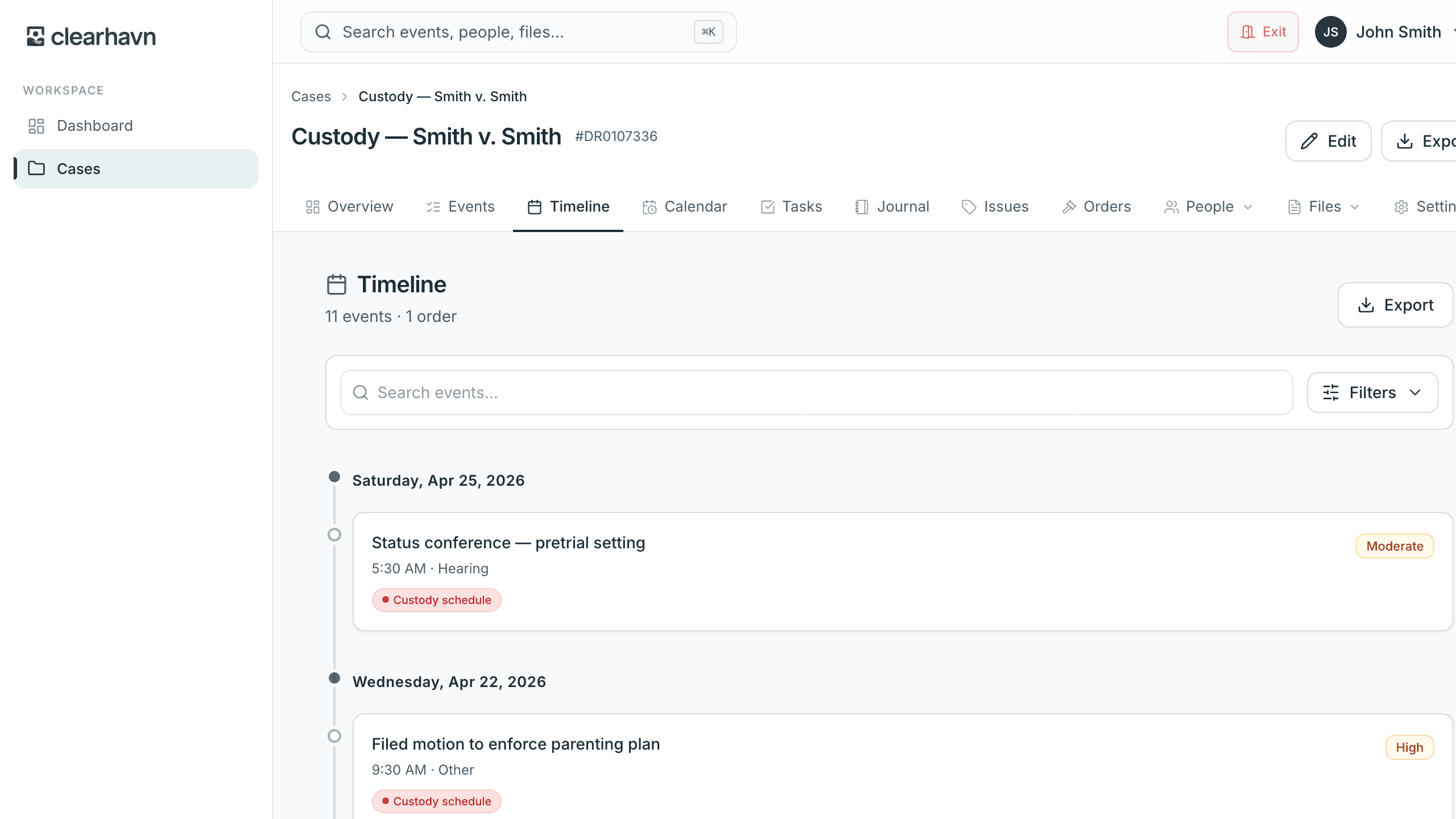
Documenting domestic violence for court is about building a record over time. Log each incident with the date, time, what happened, and severity. Attach photos, screenshots, recordings, or medical records to the incident they document. For a restraining order petition, courts need specific dated incidents, not general descriptions.
If you're filing for a protective order (sometimes called a DVPO, DVRO, or TRO depending on your state), preparing for a custody hearing after leaving, or just trying to write down what's been happening so it stops sounding small in your own head, you're doing the same work. You're building a record of incidents over time.
That work is hard for reasons that have nothing to do with organization. Memory under chronic stress is reconstructive, not playback. Elizabeth Loftus's research on eyewitness memory documents how recall softens with time, and the version you can tell six months later is almost always milder than what you actually lived. Evidence is scattered: text screenshots in one place, photos in your camera roll, medical records in an email, a police report in a drawer. Most petitions for a restraining order ask you to list specific incidents with dates. Almost no one can do that from memory under pressure.
Clearhavn is built for that documentation work. It can't make you safe. It can't tell you whether what's happening qualifies for a protective order in your state. What it can do is hold the record in one place, attach the evidence to the incident it documents, and give you a clean PDF when you need to walk into court or hand something to an advocate.
Privacy, by design
The protections you would want, said plainly.
Panic exit
A button on every screen of the app. One tap hides Clearhavn and routes to a neutral page. Use it any time someone walks up.
Session PIN lock
Set a PIN inside the app that is separate from your device passcode. The app locks after a period of inactivity you choose.
Private by default
Your case is scoped to your account. Nothing is shared without your action. Cookieless analytics. No personal information sent to error monitoring.
Your data is yours
Download a full JSON export of everything you have written, any time. Delete your account in one click — a real delete, not a soft archive.
What Clearhavn helps with
The documentation work that protective-order petitions and DV-informed custody cases turn on.
Document incidents while you remember them
Date, time, what happened, severity, who was present. Two minutes on your phone. The version you write today is far more useful than the one you would reconstruct six months later.
Keep evidence with the incident it documents
Photos, text screenshots, voice recordings, medical records, police report PDFs — drag them onto the incident they relate to. When you need them in court, they are not lost in your camera roll.
See the pattern over time
Severity ratings and issue tags surface what is increasing over time. The 'What changed' summary compares the current window to the equivalent prior window. Useful for petitions that ask you to show a pattern.
Track protective orders and court dates
Store the order itself as a PDF, from a temporary ex parte order through a final DVPO. Track expiration, modification, and any violations. Reminders before each hearing so you don't miss a date that matters.
Reminders that respect your inbox
Email or push reminders before court dates, filing deadlines, and exchange days. Set them anywhere from one hour to three days in advance, or turn them off entirely if a quiet inbox is what you need.
Court-ready chronology PDF
When you need to file a petition, prepare for a hearing, or hand something to an advocate or attorney, export a clean PDF chronology in one click. Dated, day-grouped, with evidence references. (Pro feature, $12/month, cancel anytime.)
What Clearhavn will not do
We would rather be upfront about where this tool stops.
It will not keep you safe
Clearhavn does not call for help, alert anyone, or interrupt an attack in progress. If you are in immediate danger, call 911 or the National Domestic Violence Hotline at 1-800-799-7233.
It will not give you legal advice
We cannot tell you whether what is happening qualifies for a protective order in your state, what the legal standard is, or what the judge will rule. Those are questions for a domestic violence advocate or a licensed family-law attorney in your jurisdiction (see our page on working with an attorney for what to expect from hired counsel).
It isn't invisible on a monitored device
No app can fully protect you from someone who has physical access to your unlocked phone or who has installed monitoring software. If you suspect either, the Safety Net program at NNEDV (techsafety.org) is the right place to start.
It is not a substitute for an advocate
A trained DV advocate — often free through your local shelter or the National Domestic Violence Hotline — knows the protective-order process in your state, can sit with you while you file, and often makes the difference between a granted and denied order. Clearhavn is what you bring to that meeting.
How to start
Take it at your own pace. Even five incidents you remember now is more than nothing.
- 1
Sign up from a device you trust
If you are not certain your phone or computer is private, call the National Domestic Violence Hotline first. They can walk you through how to check.
- 2
Set a session PIN
Make it different from your device passcode. Set the auto-lock to whatever feels right for your situation.
- 3
Log the most recent incident
Date, time, what happened, severity, who was present. Two minutes is enough. You can come back and add detail.
- 4
Add older incidents as you can
It's normal for this to take days or weeks. Reconstructed entries (dated when you logged them) are still useful. Honest reconstruction is generally admissible.
Resources beyond Clearhavn
Documentation matters. So does talking to someone who knows the system in your state.
National Domestic Violence Hotline
24/7 hotline, chat, and text. Anonymous. Advocates can help you with safety planning, finding a shelter, and understanding protective-order options in your state.
1-800-799-7233 · text START to 88788
StrongHearts Native Helpline
Confidential, anonymous helpline for Native Americans and Alaska Natives experiencing domestic, dating, or sexual violence. Culturally-appropriate advocacy.
1-844-762-8483
love is respect
Specifically for teens and young adults in dating relationships. Text, chat, and call options.
1-866-331-9474 · text LOVEIS to 22522
WomensLaw
State-by-state legal information on restraining orders, custody, divorce, and immigration. Plain-language guides written for survivors, not lawyers.
Online resource
Safety Net at NNEDV
Help with technology safety — checking a device for stalkerware, securing accounts, safe communication while leaving. Resources for survivors and the advocates working with them.
Online resource
RAINN
National sexual assault hotline. 24/7, anonymous, free. Sexual violence and intimate-partner violence frequently overlap.
1-800-656-4673
Common questions
- Will the person harming me see that I am using this?
- Clearhavn appears as a normal web page (clearhavn.com) or app on your device. The app has a panic exit button on every screen and a session PIN you can set. If your device has stalkerware installed or someone knows your account password, no app can fully protect you. The Safety Net program at NNEDV (techsafety.org) is the right place to check whether your phone is being monitored.
- What if they have my phone passcode?
- Set a separate session PIN inside Clearhavn that is not your device passcode. The app will lock itself after a period of inactivity. For a thorough device-safety review — especially if you suspect your phone has been monitored — contact Safety Net at NNEDV or call the National Domestic Violence Hotline.
- Are photos and text screenshots admissible as evidence?
- Generally yes, with foundation testimony from you that they accurately depict what you saw or experienced. Rules vary by jurisdiction and judge. A DV advocate or family-law attorney in your state can tell you what your court typically accepts.
- Do I need a lawyer to file for a restraining order?
- You can file pro se (self-represented) in every U.S. state, and most courts have self-help packets specifically for protective orders. But a DV advocate — free through your local shelter or the NDVH — often makes the difference between a granted and denied order, especially at the hearing. Many areas also have free legal-aid programs for DV survivors. If you do appear pro se, our free family-court objection trainer drills the most common improper-question patterns that come up in DV hearings.
- What if my situation doesn't feel "bad enough" to file for a protective order?
- Document anyway. Patterns matter. Behaviors that look minor in isolation often form a clear, escalating pattern over months. That pattern is what protective-order standards are designed to recognize. Documentation done now is also useful if you never go to court: for your own clarity, for a therapist, or for a custody case down the road.
- Can I share my record with my advocate or attorney?
- Yes. Pro plan ($12/month) includes read-only attorney sharing — a single email-scoped link, revocable any time. You can also download a full JSON export of your case at any time, on any plan, and email it.
- What if I am reading this on a borrowed or shared computer?
- Do not sign up from a device you do not trust. Use a private browsing window to read, sign up later from a safer device, or call the National Domestic Violence Hotline for guidance on safe ways to communicate from a monitored situation.
- What happens to my data if I cancel?
- Your data stays. You can keep using the free plan, download a JSON export any time, or delete your account in one click, and account deletion is a real delete, not a soft archive. Soft-deleted cases on the free plan are removed permanently after 30 days; full account deletion happens immediately.
Start with one incident today.
You don't have to remember it all at once. Log one thing, attach one screenshot, set a PIN. Come back when you can. Free for one case, forever. No credit card. Cancel anytime.