
Hearing coming up? Walk in prepared.
Whether your hearing is in four weeks or four days, the work is the same: pull your story together, organize your evidence, and present a clear record. This page walks you through how. Clearhavn does most of the organizing.
By Clearhavn editorial · Last updated
A four-week preparation timeline
If your hearing is sooner, compress this. The order still applies.
Pull your story together
- Build a full chronology of every event you intend to mention. Dates, times, what happened, who was present.
- Gather your evidence: photos, screenshots, recordings, school emails, medical records, text exports.
- Confirm the hearing date, time, courtroom, and judge. Note the address and parking.
- If you have an attorney, schedule a prep meeting now — calendars fill up.
Organize and label
- Label each piece of evidence as a numbered or lettered exhibit (A, B, C or 1, 2, 3 — whatever your court expects).
- Build a witness list with full names, contact info, and what each person can testify to.
- Print or save your chronology so you can hand it over if asked, or read from it under pressure.
- Rehearse the timeline out loud. You should be able to recount it without notes.
Finalize and review
- Print your chronology, exhibit list, and an exhibit binder with two copies of each document — one for the judge, one for opposing counsel.
- Review with your attorney if you have one. If not, schedule a single-session consultation if your budget allows.
- Confirm childcare, transportation, and what you'll wear. Reduce decision-making for the day-of.
- Plan what you'll say in the first 60 seconds. The opening sets the tone.
Show up calm and ready
- Arrive 30 minutes early. Find your courtroom and use the bathroom before you go in.
- Bring two copies of every document. Always.
- Speak slowly. Address the judge as “Your Honor.”
- Stick to facts. Don't argue with opposing counsel. Don't interrupt.
- If asked something you don't know, say so. Guessing under oath is worse than “I don't know.”
What to bring with you
The short list. Bring two copies of everything except yourself.
How Clearhavn helps you prepare
The work above is what wins hearings. Clearhavn does most of it for you.
Build the chronology
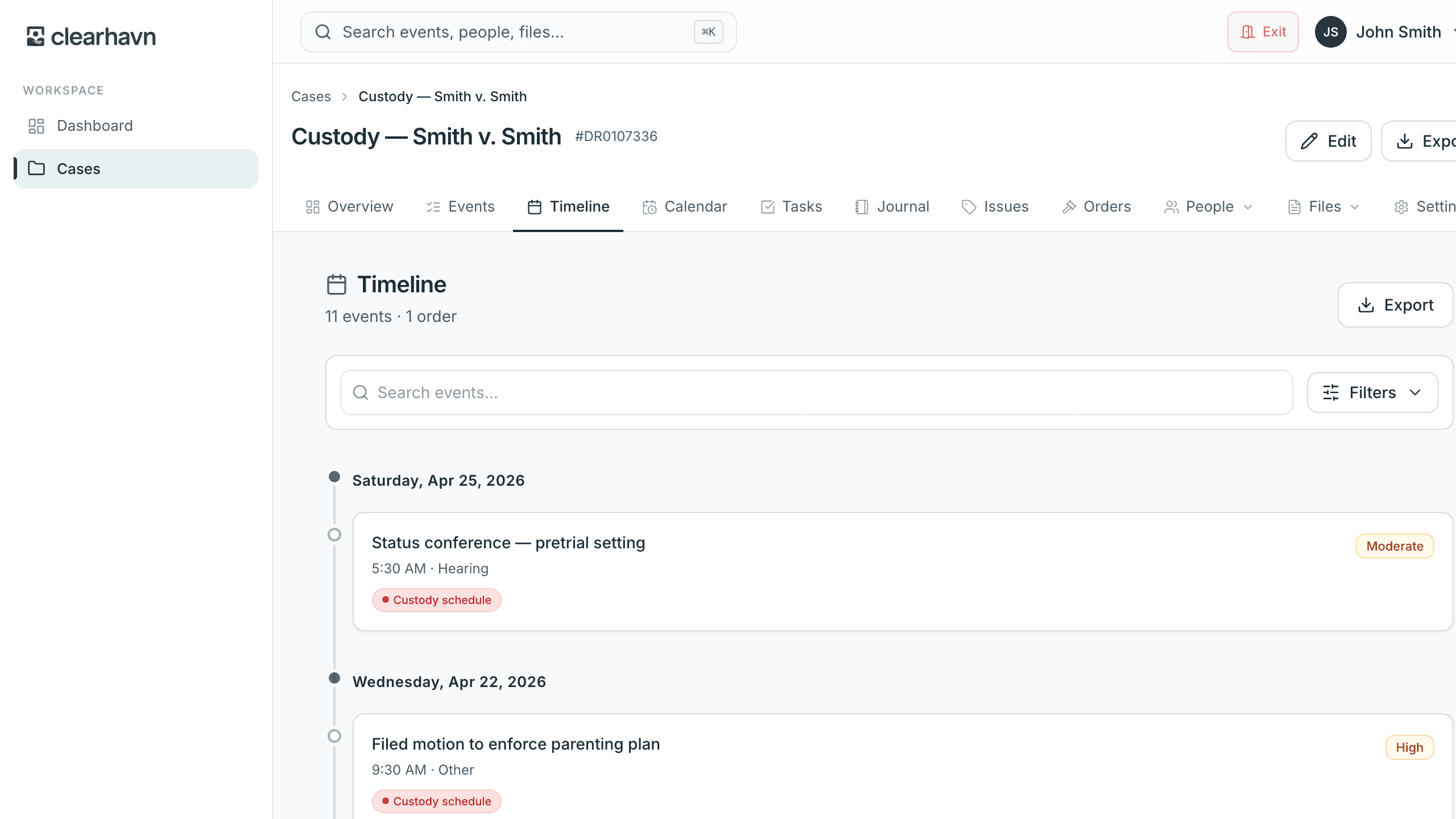
Log events as they happen, or backfill the ones that already did. Each event gets a date, category, severity, and a place to attach evidence. When you need to print it, the chronology is one click away.
Export a court-ready PDF
When the hearing is two weeks out, generate a clean PDF chronology with day groupings, severity, and evidence references. Designed to be printed and handed to a judge or attorney.
Build a labeled evidence packet
Select the evidence you intend to submit, choose a label format (A1, A2, A3 or Exhibit A, B, C — whatever your court uses), arrange the order, and export a ZIP with labeled files plus an exhibit index.
Track witnesses and parties
Add witnesses with contact info and what each one can testify about. They show up in your exported chronology, so when the judge asks, you have it.
Don't miss the date
Put the hearing on your calendar with email and push reminders. Set them for one day, three days, or a week in advance — whatever you need to feel ready.
Share with an attorney for review
If you're working with a lawyer, give them a read-only view of your case. They can review your chronology and exhibits without you sending a folder of zip files. (Pro feature.)
Drill family-court objections before your hearing
Objecting clearly, on the right ground, in the half-second between question and answer is the other half of hearing prep. We built a free trainer with 40 realistic transcript scenarios — hearsay, leading, foundation, relevance, opinion/character, privilege — with instant explanations citing the FRE rule or its state analog.
Read the four-week drill plan: How to prepare to object at your custody hearing
Also free: the Message Coach — BIFF-style help for hard co-parent texts you don't want ending up as exhibits.
Common mistakes to avoid
Showing up with everything in your phone
Judges read paper. Print the chronology, print the exhibits, print the witness list. Your phone may not have signal in the courthouse. Don't depend on it.
Bringing 200 unsorted screenshots
Volume is not preparation. A small set of well-chosen, labeled exhibits beats a binder of unsorted material every time. Pick the strongest 8 to 15 pieces of evidence and present them in order.
Arguing with opposing counsel
When opposing counsel asks a question, answer it. Don't debate. Don't volunteer information beyond what was asked. Calm and brief wins hearings.
Forgetting that the judge is the audience
Speak to the judge, not your ex. The judge is the person making the decision. Eye contact, calm tone, factual language — directed at the bench.
Not having a witness list ready
Even if you don't plan to call witnesses, having their contact info written down makes you look prepared and gives you flexibility if something changes.
Freezing when the other side asks an improper question
Pro-se litigants often miss objections in real time — hearsay, leading questions, character evidence — and the moment passes. Pattern recognition fixes this. Our free family-court objection trainer walks you through realistic scenarios with the right call and the rule cited.
Common questions
- How long does a custody hearing usually last?
- It varies — anywhere from 15 minutes for a brief status hearing to a full day or more for a contested matter. Your hearing notice may give you a time estimate. Plan to be there longer than expected, just in case.
- Is preparing for a restraining order hearing different?
- Yes — protective-order petitions usually require you to list specific incidents with dates, and the privacy considerations are different from a standard custody hearing. See our guide for domestic violence survivors for the documentation patterns and safety features that matter for DVRO prep.
- Can I bring my children to the hearing?
- Generally no — courthouses are not appropriate for kids, and most family courts do not want children present. Arrange childcare in advance. If the judge wants to hear from your child, they will usually do so privately, in chambers.
- Do I have to swear under oath?
- Yes if you testify. Lying under oath is perjury and a serious crime. If you're not certain about something, say so. “I don't recall” or “I'm not sure” is always a safe answer.
- What should I wear?
- Business or business-casual. No t-shirts, jeans with holes, or anything with logos or slogans. The goal is for your appearance to add nothing to or take nothing from your testimony.
- Can I read from my notes?
- Usually yes for facts you've already documented (dates, times, dollar amounts). Don't read a prepared speech — judges want to hear from you, not your script. Notes are a reference, not a teleprompter.
- What if I get emotional?
- It's allowed and expected. Take a breath, ask for a moment, and continue. Tissues are at the witness stand for a reason. What matters is that you stay factual and don't let emotion turn into argument or interruption.
- Can I bring my Clearhavn export on a phone or tablet?
- You can have it on a device, but always also bring printed copies. Many courthouses restrict phone use in courtrooms, and some have spotty connectivity. Paper is your friend.
Start organizing for your hearing today.
Free for one case. Court-ready chronology export and labeled evidence packets are $12/month when you need them. Cancel anytime.